Paraguay possesses ideal conditions for drug trafficking: a subtropical climate, fertile soils, forested border areas that are difficult to control, and a vulnerable rural structure. These factors are utilized by Brazilian criminal networks such as PCC and Comando Vermelho, which have even acquired entire ranches to vertically control the entire chain from cultivation and processing to export.
Paraguayan cannabis dominates the illegal market in Brazil, the destination for 77% of its production, while Argentina and Bolivia absorb around 20%, and only 4% remains for domestic consumption. If approved, Paraguay would be the first country in South America to have a legal system for recreational cannabis.
Operation “Umbral” also exposed the fragility of state controls. The volume of the seizure is equivalent to more than 13.3 million dollars on the Brazilian market and confirms that cannabis produced in Paraguay continues to be the engine of supply for criminal networks that then radiate to Argentina, Bolivia, and Chile.
The operation, carried out by the National Anti-Drug Secretariat (Senad) in conjunction with the Internal Defense Operations Command (CODI) and the Ministry of Public Security, resulted in an armed confrontation, with one member of the organization killed, another injured, and five detained.
The convoy bypassed police checkpoints without hindrance, raising suspicions of a cover-up and reviving criticism of the Pedro Juan Caballero–Ponta Porã binational corridors, the epicenter of marijuana trafficking to Brazil and the starting point for small planes that drop drugs into Argentine territory by air.
According to Senad, this blow to crime is significant. With costs starting at 6 dollars per kilogram at the plantation and reaching 1,200 dollars in Brazilian cities, the profit margin difference explains the consolidation of convoys like the one intercepted: these are industrial operations, not improvised ones.
Even long-range routes show the scale: when marijuana crosses Paraguay to Bolivia and then traverses Argentina towards Chile, the price soars to 2,500 dollars per kilogram, consolidating a regional business that generates more than 800 million dollars a year undeclared.
The domestic political debate in Paraguay contrasts with this reality. For criminal organizations, this is merely a loss of inventory within an annual scheme that moves thousands of tons. The magnitude of the seizure confirms that drug trafficking operates in Paraguay with military logistics, massive economic capacity, and levels of institutional penetration that continue to compromise regional security.
Paraguay, the largest cannabis producer in South America and the second in the world behind Morocco, officially cultivates 21,000 hectares, but experts estimate the real area could triple, with up to 10,000 effective hectares per cycle and production exceeding 30,000 tons annually.
The controversy escalated when documents of Police Chief Osvaldo Andino, director of Investigations for the National Police, were found in a getaway zone. He claimed he had lost the papers while “collaborating” with the authorities, a statement flatly denied by Senad.
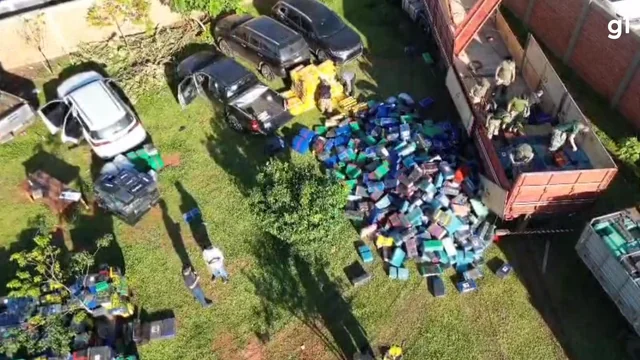
During a nocturnal deployment in Saltos del Guairá, Canindeyú department, Paraguayan special forces intercepted a convoy of 19 vehicles transporting 88,991 kilos of pressed marijuana, the largest cargo ever seized in transit in the country's history, SENAD reported.
While illegal production grows, the country maintains a restrictive legal system: since 2017, medicinal cannabis has been authorized, but with only 12 active licenses and a single product registered with THC.
The police leadership ordered the preventive replacement of all agents posted on that route and opened internal affairs investigations.
Beyond the record volume, the operation reveals the scale of the business. In parallel, the Senate is debating a project to legalize adult consumption in 2025, including a regulated production scheme and sale in tourist dispensaries.
The pickup trucks, some loaded up to the cab, traveled over 120 kilometers on secondary roads without being stopped by any of the 11 police stations located along the route.
The anti-drugs minister, Jalil Rachid, warned that such circulation can only be explained by institutional complicity or total abandonment of duty: “The vehicles were full and circulated as if nothing. It's impossible that no one saw them. Either they were paid, or they were sleeping.