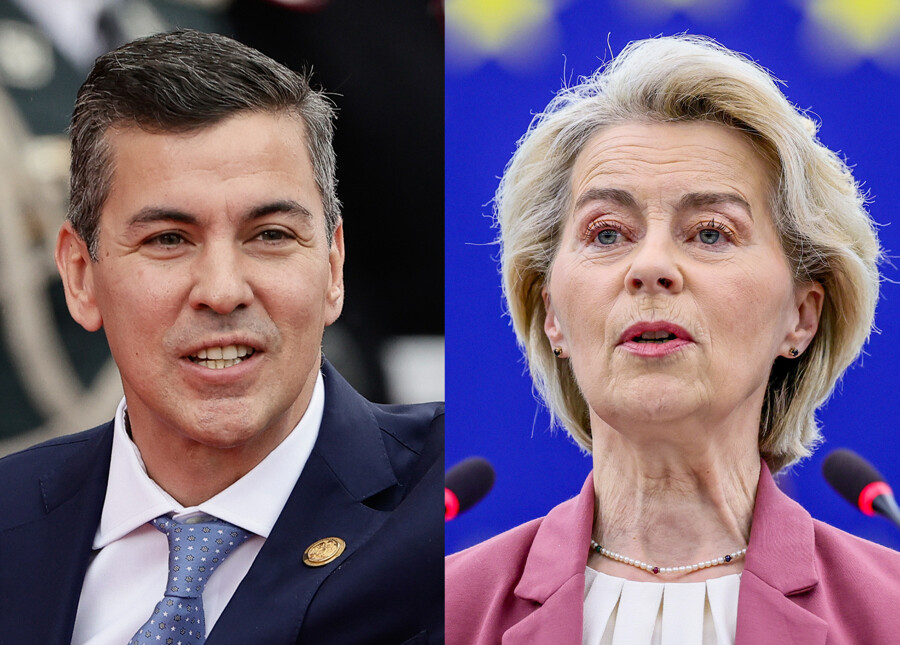
The Mercosur countries (Argentina, Brazil, Paraguay, and Uruguay) and the European Union will sign their long-awaited free trade agreement this Saturday in Asunción, at a time of growing global protectionism and geopolitical tensions. After 26 years of negotiations, representatives from both blocs will put their signatures to the document at the Grand Theater José Asunción Flores of the Central Bank of Paraguay, a place rich in symbolism, as it was there that Mercosur was launched in 1991. The trade war unleashed by US President Donald Trump, the increasing dependence on China, and geopolitical tensions, with the war in Ukraine and the crisis in the Middle East still ongoing, have pushed both sides to overcome their historical differences and seal an agreement as celebrated as it is criticized. The ceremony will begin at 12:00 local time (15:00 GMT). The agreement will create a market of around 720 million people and will cover 31 countries with a combined gross domestic product of about 24.2 trillion dollars, equivalent to just over 20% of the world's GDP. One of the central axes is the elimination of tariffs. In return, in countries like Argentina, the automotive, metallurgical, textile, footwear, and chemical industries appear as vulnerable sectors, which will face increasing external competition. Beyond trade, the agreement has a strong geopolitical dimension. Companies from both blocs will be able to compete in state tenders and provide financial, logistical, and digital services with fewer barriers, although the larger scale of European companies gives them a relative advantage in these sectors. The environmental chapter, while having a limited economic impact, carries a strong political weight. The text includes the commitment to respect the Paris Agreement on climate change and establishes dialogue mechanisms in case of potential breaches, although European environmental organizations consider these guarantees insufficient and anticipate significant rejection in the European Parliament. In terms of winners and losers, various analyses indicate that the agreement will benefit European economies, more industrialized, more, although Mercosur will also obtain benefits, especially in its high-value-added agro-export sector. The host of the event will be the Paraguayan head of state, Santiago Peña, whose country holds the rotating presidency of Mercosur. The European delegation will be led by the President of the European Commission, Ursula von der Leyen. The agreement will also include an annex on the environment and retouched chapters of interest to South Americans, such as government procurement. The text passed within the EU with the support of 21 of the 27 partners. Only five voted against: France, which led the 'no', Poland, Austria, Ireland, and Hungary, all of whom see the agreement as a threat to their agricultural sectors. Belgium abstained. The absence of Brazilian President Luiz Inácio Lula da Silva, one of the great champions of the pact, was a surprise. Brazilian official sources affirmed to EFE that, in principle, only the foreign ministers of Mercosur were summoned to the act, who will sign the treaty on behalf of the South American bloc. However, due to the historical nature of the event, Paraguay later decided to invite the heads of state of the member countries. The aforementioned sources deny that Lula's absence is due to ideological differences with any of his peers and attribute it to scheduling problems. Despite Lula's absence, Brazil, the largest economic power in Latin America and which led the negotiations with the EU, enthusiastically defends the agreement, which will create the world's largest free trade zone by population, with 720 million people and an economic weight of 22 trillion dollars (19 trillion euros). "This agreement will bring more employment, more income, it will strengthen agribusiness, industry and, as a consequence, services and reciprocal investments," said the vice president and minister of Industry and Commerce of Brazil, Geraldo Alckmin. Along the same lines, the chancellor of Paraguay, Rubén Ramírez Lezcano, highlighted, before congressmen of his country, that it is one of the "most important agreements in economic terms on the planet" and celebrated that an equilibrium has been reached, although no party is 100% satisfied. The treaty will gradually reduce or eliminate tariffs on around 90% of exports between the EU and Mercosur. It also provides for the possibility of applying bilateral safeguard measures, in case of a large price difference. However, the entry into force of the agreement will not be automatic after the signing, as several stages will still have to be completed on both sides of the Atlantic.